Production News

lensayeleL.A.’s New Film Commission

Film production in California has declined in 10 of the last 12 years. In 2003, 66% of American films were produced in California, most of them in Los Angeles; last year, it was 31%. Six years ago, 81% of the country’s television pilots were made here; in 2009, the figure was 57%. With the decline in production it makes sense to create a commission whose purpose is to bring back production, and in turn will bring back the production jobs.

Shooting in some NYC locations will cost you

Gone are the days of sending a production assistant down to the Mayor’s office the day before a shoot to obtain a free permit.  Not if you want to shoot in certain municipal buildings. There’s a new charge 3,200.00 charge and you’ve got to obtain the permit four days in advance. If you’re shooting in NYC plan ahead.

ESPN in 3-D

I’m not sure if I’m ready to see baseball player’s spit in 3-D but that’s really not the point.  With the launch of ESPN’s new 3-D channel, sports fans will be able to feel as though there right on the field.  ESPN promises 85 sporting events in 3-D this year, including the Summer X Games.

With 3-D production comes 3-D TV sets

You’ll be able to see the latest in 3-D TV sets displayed at this years Consumer Electronics Show on January 7th.  And to think, just a few decades ago we didn’t even have cable.  My entertainment options are growing daily.

5 Ways to Become a Producing Super Hero

batman_powWhy do we love Superheroes?  Because they have the power to get things done.  We’re thrilled when they fly, we’re excited when they transform, and we cheer when they destroy evil.

Producers with superhero qualities create great shows and they work again, and again and again.  So what’s the trick to unleashing the superhero in you?

Never leave home without your cape

You can either scale a wall one brick at a time like a mere mortal, or you can strap on your cape and leap tall buildings with a single bound.

Let the world know you’re the type of producer that understands that nothing is impossible; in fact you eat challenges for breakfast.  You know what the goal is and nothing will stop you from achieving it.  That means making the tough decisions about schedules, budgets, hiring, firing, re-writes and negotiating with the network.  You’re willing to be the final word and take responsibility for the outcome.

Work with other superheroes
Would Batman work without Robin?

When putting your production crew together get the best.  Hire people you’ve worked with before, or those who have been recommended by someone you respect.  Hire experts who have a collaborative nature and be willing to listen to what they have to say.

ClarkKentHT65SMKnow when the production needs Clark Kent and when the production needs Superman
If everything is running smoothly, keep your glasses on, your tie in place and suit jacket buttoned up.   At the first sign of trouble be ready to jump into the phone booth and come out flying.

Always have three or four options kicking around in the event the schedule has to change, or the edit isn’t working, or the network isn’t happy with what you’re doing.  Don’t wait until the last minute, a good producer knows when it’s not clicking, trust your instincts and be ready to change on a dime.

A Superhero isn’t always a man of steel
Where would Spiderman be without his agility?

You must be able to listen and bend but not break.  Listening to what the network wants, as well as what your writers, director and editor have to say will keep the show on track.  You will deliver more than what the network expected.

Be a Superhero
If you want to be a producing superhero, then be a good producer.
•    Learn your craft.
•    Keep current with new technology.
•    Project the attitude you’d like to see in others.
•    Be kind, but be strong.

You Can’t Get Fired For Lying

quiz_show_posterNewspapers filled their headlines with it, the United States Senate investigated it, and Robert Redford made a movie about – it was the television quiz show scandals of the 50’s.  The fallout began in 1956 when millions of Americans across the country sat in their living rooms, hunched over their TV dinner trays watching Columbia Professor Charles Van Doren answer questions on the game show Twenty One.  His final winnings totaled $129,000, the equivalent of about 1 million dollars today.  But his achievements proved false when he later revealed the producers fed him the answers to the questions before the show. The scandal not only rocked Mr. Van Doren’s blue-blood world, but wiped clean the television game show genre for years to come.

At some point America forgave and forgot, because game shows now dot the dials with every click – Jeopardy, Who Wants to be a Millionaire?, Wheel of Fortune and Deal or no Deal to name a few.  Each show features your average Joe or Jane in a mental balancing act as they try to answer questions that will take them to the next rung of the money ladder. We tune in and we root for these contestants, perhaps because they represent us.  They represent the idea that there is a level playing field where anyone can be declared a winner and take home the riches. I suppose that is what upset Americans during the 50’s scandal.  The notion that anyone could win was taken away, and they could no longer believe what they saw on TV as ‘real’ – they felt betrayed.  No one wants to be duped, no one wants to cheer and rally round anything to find out it was all false or fake – it makes us feel stupid.

angela-rippon_1533831c
Angela Rippon in the show Sun, Sea & Bargain Spotting Photo: REEF TV

So why would the BBC in 2009 present not one but two shows that were rigged?  Sun, Sea and Bargain Spotting on BBC Two is a game show featuring two competitors who bargain hunt in France and then attempt to sell their treasures in a London market for profit.  During one episode, the competitors were offered £25 for an acrylic panel from a purchaser who turned out to be a cameraman for the show.  Were they under a deadline to get the shot and didn’t have any buyers?  I can only imagine what would go through the minds of the producers who are trying finish up an episode with the clock ticking – “Just get a bleedin’ crew member to buy it, the audience will never know.”

If that weren’t enough, Trash for Cash, airing on BBC One had similar incidents of betraying the audience.  The show has regular people clear out their clutter and sell it for charity at a table outside their homes.  Here too, production staffed posed as customers.  Sound coincidental?  Well that’s because both shows are produced by the same production company, Reef Television.

225px-Vivienne_Nearing,_Jack_Barry,_Charles_Van_Doren_NYWTSReef Television was investigated by the BBC and was ordered to pay a fine and give an on-air apology.  Like the producers of Twenty One, who later went on to continue working in television, Reef Television will continue to create programming for the British Public.

It would appear, then, you can’t get fired for lying.  The question is, would you risk it to get the show “in the can”?

Can television make our children smarter?

sunglasses_2Science and math are important, but are they entertaining? Can you develop a series around these subjects that will have kids leaving the mall early or abandoning their Xbox? With the current administration’s push on Science, Technology, Engineering and Math – also known as the STEM initiative – producers are creating programming and networks are designing channels that will both capture the imagination and catapult the younger generation to the stars.

But creating programming around science and math is not a new concept. Several years ago I worked with FASE productions producing a series called “The Eddie Files”. Each episode within the series was divided into three parts. One third was set in a classroom, one third was documentary, and one third was scripted. Through the eyes of “Eddie,” a 5th grade student the show tells the story of how people use key math skills and concepts in life and in exciting jobs. The series was educational, entertaining and won a Peabody Award. Steve Heard, the President of FASE productions took what he’d already developed, which was a keen sense of how to teach these subjects through innovative television – and created The Futures Channel. The channel is an on-line, and in the schools brand of educational entertainment.

To some, the concept of education and entertainment is not always thought of in the same sentence. However, when The Futures Channel produces a segment showing algebra as a key component in creating wind sails, or engineering at the heart of a beautiful sunglass design, or science as an essential ingredient in developing new foods for space travel – then I think you’ve put the ‘e’ in educational entertainment.

If the United States is going to maintain competitiveness in the 21st century, we need to cultivate the skilled scientists and engineers needed to create tomorrow’s innovations. Television producers can strengthen the education pipeline that leads to STEM careers by creating dynamic programming. In fact, as of this writing the new educational/entertainment landscape is already taking shape.

• Discovery Communications is launching a dedicated commercial-free programming block on the Science Channel.
• Sesame Street will be featuring STEM content in twenty of the 26 episodes this season.
• Sony, The Entertainment Software Association and the MacArthur Foundation are partnering to make STEM-related video games freely available and hosting competitions and prizes for game development.

So producers take note – this is an opportunity to create programming that will shape all of our futures.

Do we really need TV news updates in the bathroom?

Bathroom newsIt wasn’t too many years ago when they put TV’s in elevators.  I must admit it was a marvel.  I could travel 32 stories straight up in a small box standing shoulder to knee with other New Yorkers and get the latest headlines, stock quotes and weather.  By the time I reached the 17th floor I was completely up to date with  world news.  Apparently that’s not good enough or accessible enough anymore, now we need to be plugged in while we’re visiting the rest room.

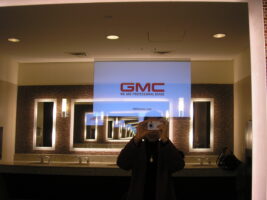
Cliché as it sounds, I never thought I’d live to see the day.  Here’s how it happened – I was at a meeting in the Time Warner Building last week, a beautiful structure located directly across from Central Park in New York City. The first several floors of the building have a myriad of shops to delight any business person waiting for their next meeting.  I was 20 minutes early for my appointment so I thought a quick trip to the public restroom to fluff my coiffure and take away the shine was in order.  Imagine my surprise when I stepped up to the wall of sinks and in addition to seeing my reflection in the mirror I saw television screens embedded into the glass.  I’m not talking about an actual TV monitor built into the glass, what I saw was the futuristic technology of a ‘television mirror’.

Bathroom News 2So astounded was I, that I whipped my camera out and began snapping away.  A total stranger who happened to be standing by the sink thought I was a lunatic to be taking photos in a public restroom. Perhaps she thought I was with the Board of Health instead of the creative person I am seizing an opportunity to share too much information on my blog.  In any event, I’m not sure my description or my photos do this technological wonder justice (where’s Ted Fisher when you need him), but I couldn’t resist capturing the moment.

After my wonderment faded (3 minutes later) I shook my head, tsk, tsked to myself and asked the question – Do we really need television in public restrooms? There are some places that should remain quiet and private without being bombarded by any sort of information.  Unless the planet is about to disappear into the ozone layer, I say leave that room public or private alone and free of distractions except for the occasional scented candle.

What about you – do you need news updates every single minute of your life?

TV Production for the small, small screen

bigbyTV’s are getting bigger while television productions are gearing up for the smallest screen in the arsenal of viewing devices – the mobile phone.   Albie Hecht, the man behind SpongeBob SquarePants is rolling out his latest animated series Bigby to an iPhone near you.

Animation isn’t cheap to produce.  An episode of The Simpsons can cost as much as 3.5 million dollars.  An animated children’s television series is probably in the 200 – 400 thousand dollar range.  But producing for a mobile phone application is cheaper and easier to distribute.   At least that’s what Mr. Hect, former President of Nickelodeon Entertainment thinks.  As the mastermind behind bringing Jimmy Neutron to the web before debuting in the movie theater, Mr. Hecht is hoping his new series does well enough on mobile phones  to justify bringing it to television and then to the big screen.

Albie Hecht is one of many TV producers creating programming for multiple outlets, because traditional just isn’t enough anymore.   Mobile is the next step.  In fact I can imagine a 5 minute daily mobile reality show, or soap opera, or game show designed for the lunch crowd to enjoy while eating their tuna sandwiches.

Will Bigby be a hit?  It’s anyone’s guess.  However, I think the first hurdle to overcome is finding 8-10 year-olds that own a iPhone.

Citizen Journalist – The New Reporter on the block

youtube2_jjpgGot a video recording device?  Congratulations you’re a journalist.  YouTube announced the launch of YouTube Direct, a new tool that allows news and media organizations to request, review, and rebroadcast YouTube clips directly from YouTube users. Let me spell it out for you.  If you have a camera, a phone that records video or a flip device you can record a town hall meeting, a fire, an earthquake, a murder, or take a public opinion poll and upload the clip for use by news organizations.  You needn’t bother learning the craft of journalism, you don’t have to know how to write, it’s not necessary to have ever worked on a video crew before, you just need a recording device that you can point and shoot and you’ve got a story.

What’s right with this picture?
This is the obvious next step in the evolution of using technology to your advantage.  News organizations can now present stories they wouldn’t have had the resources to cover themselves.  It allows them to get breaking news the millisecond it happens without ever sending a reporter or crew to the scene.

What’s wrong with this picture?
If you know me you know I’m not enamored with the news media in general.  You’ll know that I don’t think we receive fair and balanced or even accurate reporting from many ‘respected’ outlets.  You’ll know that news journalist often misquote their sources, and that the more horrifying the headline the better.  What passes for news today in the alphabet soup of 24 hour news stations like CNN, FOX, and MSNBC,  straddles a very thin line between fact and  the ‘host’s’ viewpoint. This is not news; this is cooking up the news.  Its opinion wrapped in a fact or two, with a dash of hubris, a sprinkling of humor, and a smidge of weightiness thrown in for credibility.  Citizen journalist is just the very next step in the evolution of 24 hour news coupled with 21st century technology.

However, I believe citizen journalists may take a step that many journalists wouldn’t– and that’s ‘creating’ the news.  Do I need to remind you of the Balloon Boy fiasco?  His alleged disappearance spread on Twitter faster than you could type 140 characters.  Most people just hit the retweet button.  It was ‘news’ that was spread to hundreds of thousands of people before anyone realized it was TOTALLY MADE UP.   It’s sad, but people do want their fifteen minutes and they want to be heard.  Millions of blogs are proof of that.

As citizen journalists enter the lexicon of our ever increasing all media world – what can we count on to be true?  Considering how far we’ve come from the Walter Cronkite days – how far will we go?  Will we each have our own channel as Twitter, LinkedIn, and Facebook merge?  Will our channels have news we create?  Will I be able to friend someone half way around the world and get their viewpoint of the news, news that is happening in their country?  If so, then we’re creating a world where the news is all about someone’s viewpoint and opinion and not about facts.

We all have opinions, and some of us even have cameras.  It’s a perfect combination for home grown news.  Welcome to the 21st century Citizen Journalist.

What’s your thought?  How do we keep the news from becoming a potpourri of individual opinions? And do you want to?

Are Show Runners like Great Conductors?

leonard_bernstein_bwA conductor’s role is to make sure the orchestra plays together and is well balanced. A great conductor, together with the orchestra makes music. And that’s really what a show runner’s job is — to make sure everyone in his or her ‘orchestra’ plays together and creates compelling television people want to watch. Achieving that goal can be compared to the various styles of great conductors.

The Happy Happy Style
The show runner is cheery creating an atmosphere of autonomy amongst all the individual members of the production team. However, if everyone is in charge, and no one is the leader,  it tends to create an atmosphere where mistakes are made and it takes twice as long to make a decision.

The Do It My Way or Die Style
Here the show runner has no time for anyone’s input or creative viewpoint. It’s solely about his vision — there’s the door, don’t trip over the carpet while you’re leaving. This is the atmosphere we all dread. This is the job where you count the days until the wrap party.

The Read My Mind Style
You’re never sure what the show runner is thinking. All notes are vague and ethereal. This creates an atmosphere of frustration and long days of constant re-writes, revisions and re-edits.

The Open Space Style
Here you receive clear direction but are also free to contribute your creative viewpoint to the production process. This is the job you wake up early for.

Which style is right? I’ve seen variations on all themes. In the end, it’s about creating a show that gets ratings. Personally, I’m also the type that feels the process needs to be just as creative and enjoyable as the final product.

Below is a terrific talk given by Israel conductor Itay Talgam comparing the conducting styles of Carlos Kleiber , Riccardo Muti, Herbert von Karajan and Leonard Bernstein and how they relate to leadership. While this video is 20 minutes long, I encourage you to watch because Mr. Talgam gives an absolutely delightful, funny and enlightening presentation that can be used in any leadership role. Enjoy!

Behind the making of Reality TV Shows

LA_InkMatthew Ostrom is the VP of Current Series and Development for Original Media. Matt and I worked together several years ago and since then he’s been busy creating original programming for a wide variety of networks.  In his current position he has executive produced a large slate of original shows including King of Dirt, Masters of Reception, Swamp People, Destination Design, LA Ink, Storm Chasers, BBQ Pitmasters and many more.  I asked Matt to give us an inside look into how a show goes from an idea to a series.

How did you get involved in production and development?
Matt: I started doing television production in college and then moved to New York City for an internship at HBO my senior year.  At the end of the internship I stayed in the city to start working in production.  I have done a little bit of everything in the television world since then – working and collaborating in reality, hidden camera, game show, comedy, scripted hybrid and talk/variety shows.  I have spent time in front of the camera and on stage as well, and those experiences helped to inform my producing style.  It is a very competitive industry and my diverse background has employed me through lots of ups and downs.

king_of_dirtWhat are some of the deciding factors that can make an idea into something you’d want to develop into a pilot?
Matt: It depends on the show, but for me 99% of the time it’s character – a big, dynamic character in a unique world. So much of the type of docu-soap programming I make starts with a person at the center of a world that is the best at what they do, or is an expert above all the rest.  The type of personality that you can hang a show on. At the center of LA Ink (TLC) is Kat Von D, a compelling personality with an amazing talent.  The King of Dirt (DIY Network) is a simple landscaping show, but at the core of each episode are Gino Panaro and his brother, Ralph. The make amazing landscapes and drive each other a little nuts – in a fun, dramatic way.

Why don’t some pilots make it?

Matt: The unfortunate fact is that most pilots don’t make it.  If one out of ten goes to series, that’s considered successful.  During the pilot phase, you are trying to figure out what the show is, how it works and what the structure is, but there are lots of factors and influences that can throw your project off-track.  Sometimes you have an idea in mind, and sometimes that idea does not translate to screen as well as you hoped.  Or sometimes the network that bought the pilot sees the show differently than you do, and their changes can effectively kill the project.  Sometimes pilots come out great, but the network changes its mandate (e.g., they go from being a lifestyle channel to a cooking channel) and the pilot you made no longer fits on their network.  There are lots and lots of ways a great television show can die.

Was there ever a pilot you made that you were sure would be picked up as a series and wasn’t?  Why?

Matt: Yes.  I did a game show that everyone loved for a music channel.  The network did focus group testing (where they present new shows to large groups of people and find out what these audiences think of them), and the show did really well.  Everything looked great, and the day before the network was going to make a decision about ordering the show, the leadership of the network changed.  When that happens, a new General Manager (GM) is brought in, and when a new GM comes into a network, they often wipe the development slate clean by killing projects that the previous GM was working on.  It’s unfortunate, but a new GM is there to make their own mark with programming they develop.

Storm_ChasersWhen a pilot is picked up by the network what are some of the first things you need to do to create a show that will have ‘legs’ for  13 or more episodes?
Matt: To be honest, you really don’t want to do a pilot.  The goal is to walk into a network with a short tape that demonstrates what the show is so that the network development folks want to go straight to series.  This tape has to be awesome – like “make the hairs on your arm stand up” awesome.  If you make a pilot from that tape, it gives the network another chance to find something “wrong” with your show.  Networks can always find something “wrong” with a show, and once you get into a situation where they’re testing and thinking and time is passing, your chances of going to series start to go down.  With that said, sometimes you can’t avoid going to pilot, and it’s in that pilot that you want to demonstrate that the world you are making a show about has lots of stories to tell.  You can help to illustrate that by writing up paper that talks about future storylines or events that are coming up.  Anything that lets the network know that this could be a show that could last a long time with lots of possibilities, lots of exciting things to see.

How does your role change once the show goes from pilot to series?

Matt: It gets easier (hopefully).  The pilot is all about figuring out the formula, doing all the creative heavy lifting.  Once a show goes to series, I hire someone called a showrunner who handles all the day-to-day operations of running a show.  If I hire a really good showrunner than I can sit back and monitor the show from afar.  If the showrunner has trouble, or the talent on the show has problems, then I get involved.  I always say, “my phone only rings when things go to hell.”

Describe a typical day.
Matt: No day is all that typical.  I will check my fantasy football scores first thing in the morning.  Then it’s off and running.  I will screen cuts of shows, give notes, talk to my showrunners and help them problem solve….  I will listen to pitches, meet with network executives and give pitches for shows, or travel into the field to direct pitch tapes.  I spend a lot of time on the phone with network executives who are overseeing my shows.  My day usually starts off calm, and by 4pm, I find that I usually have not eaten lunch and I’m asking myself “what the hell happened to my day!”

Any advice for creatives out there that have an idea of a television show?
Matt: You can pitch to networks.  They have development departments, and they’re always looking for good ideas.  Just pick up the phone and make an appointment. Depending on your level of experience in television, it may make sense for you to partner with a production company.  I would recommend matching your idea with a production company that has a track record for doing that type of programming.  For example if you have an idea for a game show, go to a production company that has a proven track record of making hit game shows.  A company with a track record can get your idea into a high level person at a network, and maybe right to series!  Good luck!

Matt, I appreciate your time, thanks for joining us to day.

Matt’s recent series and Executive Producer credits at Original Media include:
King of Dirt – A how-to-landscaping show for DIY that mixes reality with instruction.
Masters of Reception – A docu-series for TLC set in the behind-the-scenes world of New Jersey’s most successful wedding catering company.
Swamp People – A docu-series for The History Channel set in the swamps of Louisiana.
Destination Design – A home makeover show for HGTV that uses inspirational travel to transform homes.
LA Ink – A docu-series for TLC starring Kat Von D set in and around the tattoo scene of Los Angeles.
Storm Chasers – A series for Discovery that follows a team of scientists and filmmakers as they attempt to intercept tornadoes.
BBQ Pitmasters – A competition docu-series for TLC about the world of competitive BBQ.
Tough As Nails – A docu-series for HGTV centered around one of Boston’s best female homebuilders.
Flowers Uncut – A docu-series for TLC about world-renowned florist, Jeff Leatham.
Duel Survivor – An adventure survival series for Discovery.
Be Good Johnny – An eight part series for The Sundance Channel that follows Johnny Weir on his quest to Olympic glory.

TV and Film People Break the Rules on Twitter
(l-r) Julie Keck, artist, me, Jessica King

(l-r) Julie Keck, artist, me, Jessica King

Social media experts have devised a formula for success on twitter: 70% sharing information with others, 20% engaging in conversation and 10% promotion.  I’ve never been one to follow rules – it’s  not that I generally work outside convention, but when I hear the words ‘should’ or ‘must’ I tend to closely inspect the source and see if it’s right for me before I blindly follow.  However, following is what it’s all about on Twitter.

I tend to follow TV production people and film makers.  I would definitely call this group ‘rule breakers’.  Seriously, can you make a film or television show without breaking some rules?  By nature, this is a group that likes to talk and needs a place to promote their work.  That’s why I follow this group, I enjoy the conversation and I want to know what’s happening in the industry.  When some of the people I follow converse 50% of the time, promote 30% of the time and share information 20% of the time, it doesn’t bother me – we’re creatives not mathematicians.

Without a little rule breaking I would never have seen the film “Snow Bunny” at the Queens International Film Festival last night by the talented filmmakers @kingisafink Jessica King and Julie Keck from Chicago. (It was great meeting you Jessica and Julie, nice to put faces to the tweets.)

I also wouldn’t have known that  @MatiasB just completed shooting a profile of the US alpine ski team that will air on NBC January 30th at 8pm.

I would never have had ‘conversations’ with TV producers @jokeandbiagio and discovered their terrific insights into making reality TV shows

I wouldn’t have discovered the truly remarkable viral distribution David Baker is creating with his film MissionX. @indiemoviemaker

And I wouldn’t have seen the very clever shorts created by filmmaker @philontilt

If you want to meet people in your industry, be inspired by others, then get on Twitter.  Break some rules, follow and unfollow people as you like.  And when you read about how things are ‘supposed’ to be done in a social media venue, be a creative, question it.  Is it right for you?

What has Twitter done for you lately?